


Why The XRP Supply In The Billions Is Not A Problem
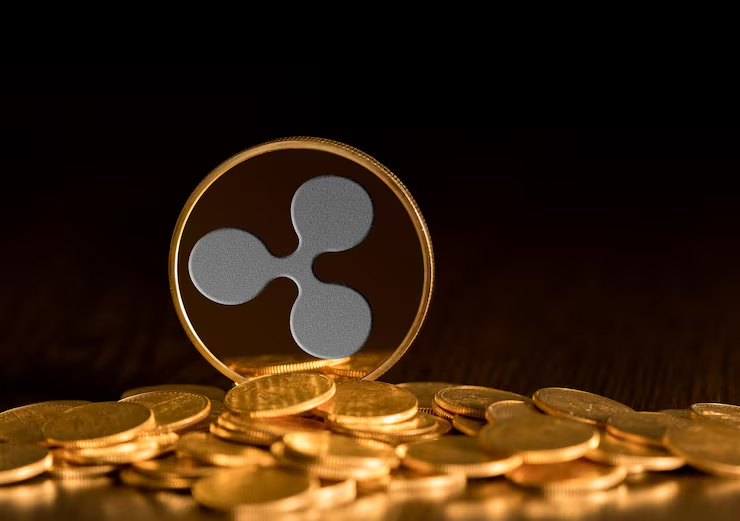
Crypto analyst X Finance Bull has laid out a detailed theory explaining why XRP’s large token supply, often criticized as a weakness, could actually serve as a powerful mechanism for institutional adoption. His analysis comes as XRP community members to help reduce supply. In contrast, others demand that Ripple to drive scarcity and trigger a price spike.
The XRP Supply Is A “Catalyst”, Not a “Problem”
In an X post on March 18, X Finance Bull that many people tend to look at XRP’s substantial supply of and, as a result, become alarmed, often describing it as a problem. He explained that the main concern about XRP’s supply stems from the belief that, estimated at between 39 billion and 44 billion XRP.
However, instead of seeing this as a negative, the analyst suggested that XRP’s large supply could actually be a “catalyst.” He argued that Ripple’s current concentration of XRP places the company above, which evaluates whether an affiliated group holds 20% or more of a digital asset.
X Finance Bull explained that Ripple’s large reserve creates a strategic opportunity to distribute between 20 million and 25 million XRP to institutional partners. Some of these include banks, liquidity providers, payment companies, central bank infrastructure partners, and tokenization platforms.
As these tokens gradually move from escrow into operational use, the analyst expects Ripple’s total XRP holdings to drop below 20% eventually. Consequently, this shift could strengthen decentralization, increase regulatory comfort, and open the door to broader institutional participation.
Building on this outlook, X Finance Bull outlined what XRP’s supply structure could look like after Ripple completes its distribution. He projected that the crypto company would hold around 18 billion XRP after the transfer. At the same time, banks would own 12 billion, liquidity providers roughly 10 billion, exchanges around 8 billion, payment firms about 6 billion, and public holders retaining approximately 46 billion.
The analyst further argued that when institutions receive these tokens, they would not sell them but would instead use them to power. In a real-world scenario, he said liquidity providers would maintain large pools of XRP, while payment companies would operate live corridors, all of which would sustain operational demand for XRP. At the same time, he expects for cross-border liquidity, tightening its circulating supply and supporting its price growth as demand expands.
The Broader Case For XRP’s Projected Institutional Future
Beyond supply dynamics, X Finance Bull noted that several real-world developments already support the framework he described. He pointed to, which he noted is already active, along with approximately $1.4 billion in ETF inflows and around $2.3 billion in tokenized.
The analyst also mentioned the pending national bank charter for Ripple and the company’s continued global expansion and corporate acquisitions as signs that the institutional layer is actively forming around XRP. Furthermore, as the CLARITY Act approaches, the new framework could play a significant role in shaping how institutions view XRP and other digital assets.
Related Articles

Dan Hillery: Digital Credit Could Rival BTC’s $1.5 Trillion Market Cap
Read more →
Treasury Sanctions Iranian Crypto Exchange BitBank Over Bitcoin Transfers to IRGC
Read more →
Bitcoin Price Unlikely To Be Bothered by Interest Rate Hike: Grayscale
Read more →Bitcoin ETFs Could Triple Gold Counterparts as Asset Matures: Expert
Read more →
SEC Green Lights Tokenized Stock Trading Despite Clarity Act Fail
Read more →Ric Edelman: Buying Bitcoin Today Is Like Buying Amazon in 1999
Read more →
From Information to Action: MEXC Upgrades AI Across the Trading Journey
Read more →
HTX Research Examines Stock-Linked Memecoins: A New Connection Between Equity Assets and Crypto Liquidity
Read more →
Unlocking the Trillion-Token Era: B.AI’s Global Settlement Layer for the Agent Economy
Read more →